



I get it, Japanese bureaucrats! You want your country to be financially secure in its old age. But things aren’t looking good. As a nation, you’re more aged and less fertile than ever. More Japanese grown-ups are in diapers than kids. Your demographics preclude any kind of traditional economic growth. Your safety depends on an increasingly weird relationship with an increasingly unstable ally, who also happens to be in diapers. And speaking of asses, regional rivals are threatening yours, militarily and musically.
Pop culture is a bright spot on an otherwise depressing national balance sheet. So you go all in. You launch a “New Cool Japan Strategy.” You declare that you’re going to make the production of content the pillar of your economy. You boast that you’re going to dump 50 billion yen – wait, 100 billion yen – no, 500 billion yen into the content industries. You will stop at nothing less than doubling – no, tripling! – the foreign market for Japanese cartoons, games, movies, and music by 2033.
Sounds cool! But there’s just one problem. You’re bureaucrats. Despite what anime-style recruitment websites might hint to the contrary, your career has been spent in the uncoolest of Japans. You’ve consumed plenty of comics and cartoons and games and books and movies, but you have no idea how they are actually made. Like most consumers, you remember the successes, and forget that failures far outnumber them. This lack of expertise plagued the “old” Cool Japan program. Remember that? Terrified of getting called out for wasting taxpayer money, you only bet on things that were already successful. But big-name creators like Takashi Murakami and Gackt wanted nothing to do with you. And the “pet projects” of your Cool Japan Fund executives plunged it 54 billion into the red. Sumimasen!
So. Back to the drawing board with the New Cool Japan Strategy. You don’t have taste (which isn’t a bad thing.) You don’t want to involve yourself in the content (which is a very good thing, lest you create a New Cool Propaganda Strategy.) But you need some metric to formulate plans, set goals, propose returns, to secure that tasty slice of the national budget pie. You’ve got it: numbers!
Now you’re talking. There’s no calculating a hit, but numbers can be crunched. Numbers mean unsheathing those twin katanas of the public servant: Powerpoints and PDFs. Within the comforting confines of a slide you’re a pop star, a manga hero, a game protagonist, building inventories of data, slicing and dicing charts, weaving spells of macros and formulas, slaying it with animated transitions, sallying forth into the unknown on a quest – numerically speaking, of course.
Speaking of tasty pie, did your boss catch that totally sick color gradient you slipped into the chart on page 67? The one about agricultural exports. Wait, what does agriculture have to do with pop culture? Sorry. Don’t stop, you’re on a roll.
I mean, check out your moves, Japanese bureaucrat! Don’t play coy. You know what I mean. Yeah, the recent Cabinet report. The one where you took a hodgepodge of cultural products — cosplay! anime! manga! robots! uh, management systems!? — then tied them all together with a singular, penetrating analysis: “something Japanese-y.”
My friend, if there were an Olympics in making Powerpoint charts, you would have taken home the gold.
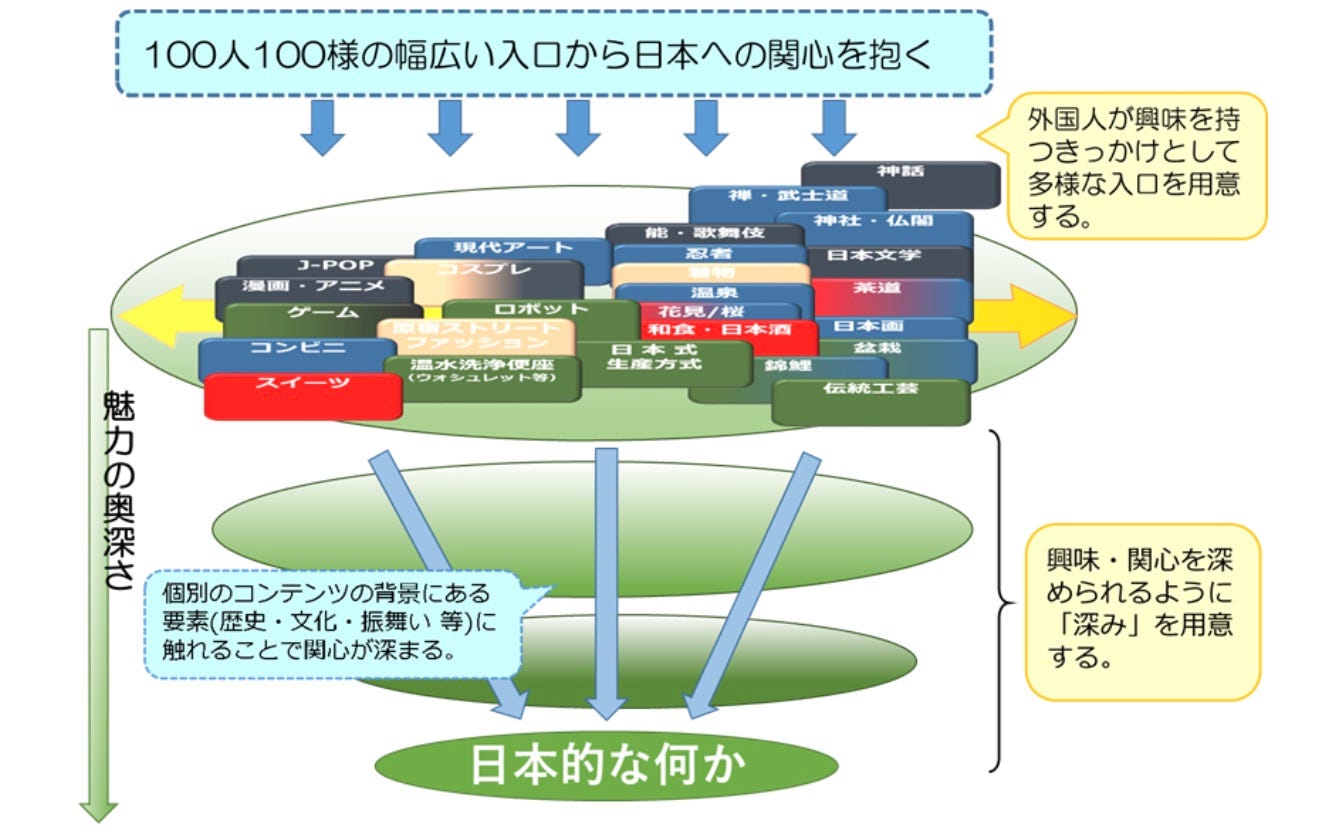
But top men, and the very occasional woman, know numbers can only tell you so much. They’re great for telling you what’s already out there. What succeeded. How much money was made. They’re not so great at telling you what isn’t there, which is to say what’s next. And that’s the supposed point of the New Cool Japan Strategy, right? You’re trying to make sure your nation’s creators have everything they need to make The Next Big Thing.
Like, say, this announcement from yesterday, dropped conveniently on a Sunday when nobody was paying much attention. You very quietly articulated a bold concept of a plan. You will invest 11.5 billion yen, equivalent to $70 million USD, in fifteen companies key to the production of anime and manga, for the purposes of translating and promoting their content. Enrich the country! Strengthen the animated forces!
Wait a second. You’re giving money to Crunchyroll, Shueisha, and Sony? Aren’t these all huge, profitable companies already? Maybe not. I mean, you never know. Let’s check the 2025 stats. So Shueisha made… 229 billion yen, the equivalent of $1.4 billion dollars. Wow. Crunchyroll reported 485 million yen in profit, a little under $3 million USD. Now, admittedly, that was half of what they did the year before. Maybe they do need a helping hand from the government. Wait — who’s their parent company? Ah, right, Sony. But maybe they’re struggling too. Hold on. Last year Sony made…Oh man. 1.5 trillion yen in sales. Double wow. I mean, to be fair, that’s only $9.92 billion USD. It’s practically slumming it compared to, like, a $10 billion USD company, right?
Okay, fine, you’re giving billions to companies that already make billions. But for what? “To boost the combined number of subscribers to the recipients’ services to 300 million from the current 100 million,” sources say. Okay. So seventy million in subsidies, divided by fifteen… That’s around 4.6 million USD. That comes to 0.046% of what Sony/Crunchyroll made last year alone. If spending that amount would triple their subscriber base, wouldn’t they have, like, done it already?
Hold up, you’re saying. Slow your California roll. You’re doing something different this time. Generative AI! What’s generative AI? I mean, you’re not sure. And how will it help publishers and anime studios and music companies without putting the creators out of a job? You know, the ones you’re depending on to make your content industry three times bigger than it is right now? Well, you’re not sure there either. But look — mentioning generative AI sure makes the money flow! Plus, AI worked great for accelerating America’s government. Sure, not in the direction most of its citizens hoped. But it did… something.
I wish you luck, Japanese bureaucrat. I really do. Nobody’s ever yoked their nation’s entire fate to their entertainment industry before, so where you’re going, there are no roads. I want those who make pop culture to succeed. I want Japan to succeed. But I don’t think you’re going to do it by delegating the creative aspects to machines —or more precisely, to the entrepreneurs who’ve convinced you their machines can do what they’re saying they can. They cannot.
With your numbers you chase efficiencies and optimizations. But making manga and anime and music and films and books and games is never going to be efficient or optimized. Believe me, I’ve been watching it happen for twenty-plus years. It’s painful and awkward and weird and unpredictable. It isn’t something you can calculate. But that isn’t a shortcoming. That’s exactly what makes it so very, to borrow your own words, Japanese-y. Most of all, I hope you don’t lose that along the way.
It is so sad. If they really want so succeed and innovate they should give some help to young and new creators and small studios and publications. As you said, in culture and entertainment success is kind of unpredictable and I think you cannot repeat a formula, so not taking ricks in cultural politics is leading it to exhaustion.
I went through a gangsta phase where I fantasized about being Tony Montana or Don Corleone. Now I just follow the Japanese government with the intensity of the Sopranos.