


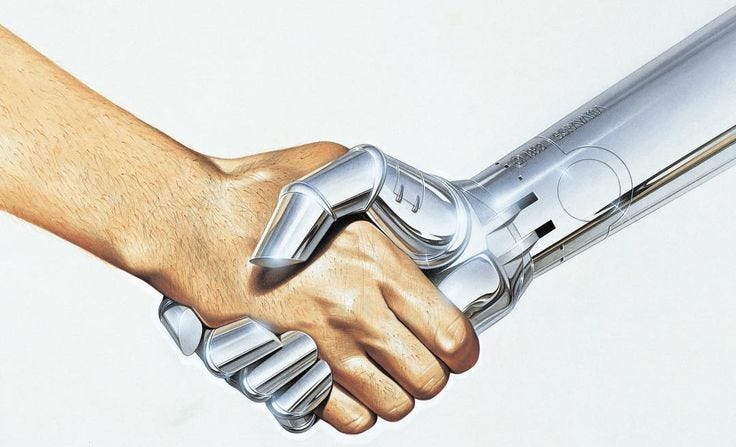
The citizens of Japan seem to view AI differently than the citizens of my homeland of America. They feel more open to it, more positive about its uses. Over the past few months, I’ve seen this affinity for AI expressed in many ways. Let me tell you a story about one experience that really opened my eyes to Japan’s seeming love affair with the technology.
Last fall, just before winter came to the mountains, Hiroko and I went climbing in Toyama prefecture. We climb for many reasons, but one of the biggest is to unplug. On our way down from Mount Tateyama we returned to Murodo, the gateway to the area, a basin-like plain where all of the hotels and inns are located. At the base of the trail, where dirt turns to boardwalk for more casual visitors, we encountered a man who was strangely plugged-in.
He dressed less like a hiker than a denizen of Akihabara, in well-worn cargo pants and parka, baseball cap spun backwards and thick glasses. He shouldered an expensive-looking single-lens reflex camera attached to a tripod. Mounted atop the camera, horizontally, was an iPhone, which I assumed was a bigger viewfinder. As he took photos of seemingly random scenery, the man kept up a steady banter with what I assumed was a friend whose voice I could hear faintly over the speakers. As we stopped together near an overlook, I realized I was wrong about both presumptions. He wasn’t talking to a friend at all. He was speaking to an AI, its faux-female voice cheering him on in Japanese. The iPhone’s camera was serving as its eye.
“You made it all the way to the Jigoku-dani valley overlook,” the AI said encouragingly (and correctly). “Good job! Pachi-pachi-pachi,” it continued, speaking the onomatopoeia for applause. “Did you see any ptarmigans? This area is famous for them.”
“No, not yet,” he mumbled, as he adjusted the lens for a shot. “Physical AI” is a buzzword in the tech industry these days, meaning getting AI off of screens and into devices such as robots that can interact with the world directly. But here was a guy who’d figured out a way to bootstrap an ersatz hiking buddy to keep him company in the mountains.
Never mind that there are plenty of hiking clubs filled with potential buddies of the human variety out there. And far be it for me to judge someone else’s wacky life choices. I tell you this story because it was my first inkling of how Japanese seem to view AI technology differently than many Westerners do.
When photo-to-video generators arrived, many of my fellow Americans reacted (and continue to react) with horror and outrage. Meanwhile I’ve watched Japanese friends and even creators post generated video after video on social media. Books about harnessing the power of AI get prominent display at Japanese bookstores and on Amazon Japan, many framed as get-rich-quick schemes. It’s a kind of techno-prosperity gospel that reminds me a little of Japan’s headlong rush to modernize at the turn of the 20th century. Earlier this year, an AI-generated manga hit the top spot on one of Japan’s biggest ebook stores, to little if any criticism. (Local readers declared the story “boring,” but pronounced the “sexy parts” to be “higher quality.” Make of that what you will.)
A great many Westerners regard AI (or perhaps more accurately, the billionaires who control it) with a mixture of deep suspicion and open hostility. A third of Americans surveyed believe the technology has the potential to end life on Earth. Contrast this to a Nikkei BP survey conducted at the end of 2025. “Japan is optimistic about AI, with 44% believing it is not a threat, unusual for a developed country.” (Apparently they missed the survey where 87% (!) of Chinese claimed to trust AI.) Whatever the case, if Japan is really more upbeat about AI than citizens of the English-speaking world, why might that be?
“The human race is now poised on the brink of a new industrial revolution that will equal, if not far exceed, the first industrial revolution in its impact on mankind.” Sounds like a post by any given AI accelerationist, but it’s actually from a 1980 cover story in Time called “The Robot Revolution.” What seems a unique moment is actually a rerun. Long before AI began disrupting creative processes, industrial robots disrupted manual ones. “If robots can do men’s work faster, better and more cheaply, then what will men do? They will be retrained for other things, the robotmakers answer. But by whom, and for what?” asked Time, echoing a now familiar-sounding existential crisis.
In another prequel of the current moment, Western leaders believed that whoever automated their factories quicker would achieve dominance over the global economy -- and that foreign competitors were even further ahead. “If we don’t go to robots,” Time quotes an expert at Carnegie-Mellon as saying, “we’ll just continue to lose to Japan... Our economy won’t grow, and there won’t be any new jobs.” In 1980, when this quote is from, Japan was producing five industrial robots to every one America did. Replace “robots” with “AI” and “Japan” with “China” and you get similar hand-wringing headlines today. It’s as though we’ve automated the angst about automation.
Observers have pointed to spiritual traditions as the root of these fears. In the Judeo-Christian West, this thinking goes, humans sit atop the natural hierarchy, and anything that disrupts said hierarchy is inevitably seen as a horror. Frankenstein’s monster is the archetypical abomination, paving the way for modern antagonists like The Terminator, the “hosts” of Westworld, Bender from Futurama, or M3GAN.
In contrast, Japan’s “indigenous religion, Shinto, explains its fondness for robots,” a typical counter-argument would have you believe. “Shinto is a form of animism that attributes spirits, or kami, not only to humans but to animals, natural features like mountains, and even quotidian objects like pencils... Japan’s animism stands in contrast with the philosophical traditions of the West.” In a land legendarily home to eight million gods, the idea there might be a ghost in the machine does not seem to horrify the Japanese as much as it does the monotheistic Westerner. Astro Boy, Doraemon, and a bevy of friendly robot characters prove the point. QED.
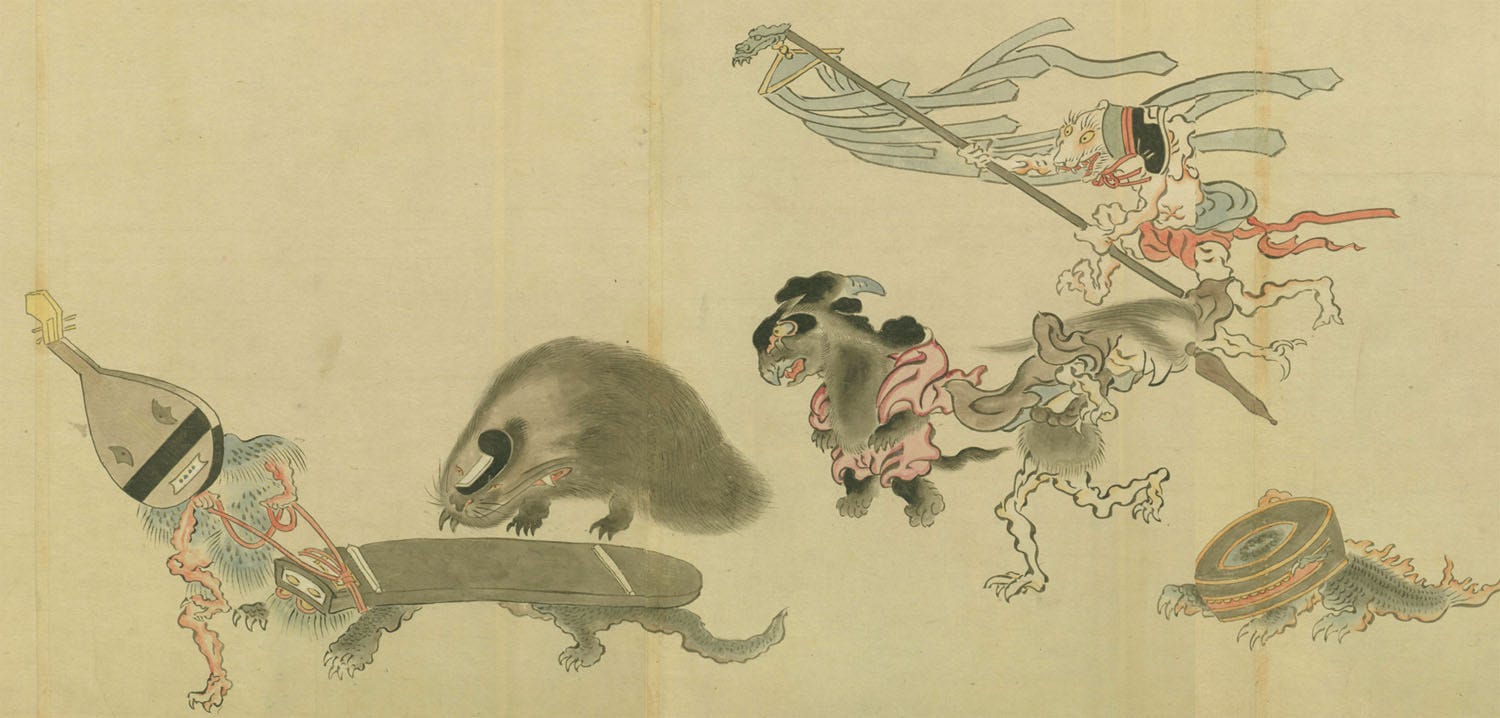
Yet when you start tugging at the threads of this argument, it quickly begins to fray. Weren’t C-3PO and R2-D2 on the side of the Rebels? Didn’t the T-800 become a surrogate father in Terminator 2? Weren’t humans the bad guys and AI the good guys in The Creator? And there are no shortage of scary machines in Japanese lore. Bahamut, the AI that imprisons humanity in Megazone 23; Project 2501 in Ghost in the Shell; countless bad-guy robots from the cartoons of my youth. And then there are the tsukumo-gami, yokai of human-made objects turned monsters, from ancient lore. There are scrolls of such terrifying parades going back to the 1500s. Just because they’re animist doesn’t mean they aren’t out to get you.
So. Where does this leave us as regards Japan’s affinity for AI? Consider that, as I wrote last year, Japan is still not a major player in the AI space. (More than a few of the big names here are actually run by Silicon Valley refugees who wanted to live and work in Japan -- not that I can point a finger!) The Japanese government has pledged to spend more on AI, and more domestic companies are getting involved in the space, but again, Japan has yet to emerge as a leader on a global scale.

The fact that Japan isn’t on the bleeding edge of AI is the real reason why Japanese appear open to the technology. Being behind the curve gives Japan a freedom to experiment with AI in ways that the disrupted West can’t. I’ve written about how Japan is a “super Galapagos,” meaning that having fallen behind other advanced nations is proving a kind of secret superpower; this is another facet of that thesis. With no domestic Japanese AI mega-companies, there isn’t anyone capable of forcing the technology down throats, as is happening in the US. Japanese society hasn’t been disrupted by AI, so six out of ten view it positively. Meanwhile, in the US, six out of ten Americans surveyed in 2025 said they wanted more control over how AI was used in their lives.

And can you blame them? Again, compare and contrast. Japan’s LDP has made some boneheaded statements about AI but there’s no sign that the nation’s leaders are looking to abdicate their responsibility for governance to algorithms. In America, a billionare techbro convinced the President to let him launch an AI war on government agencies, all the while looting government databases for more data to train his company’s AI models.
This is precisely why AI has become a litmus test in the US, where support or skepticism has become linked to one or another political camp. That hasn’t happened in Japan, as of this writing, anyway. Then again, Japan simply isn’t as politicized as the US. Speaking openly about politics is frowned on, even seen as taboo.
Compare this to America, where everything is filtered through politics (and more specifically, one reality show host turned politician’s cult of personality.) Where you stand on any given issue is no longer your opinion but your identity, so that you can be quickly sorted into one tribe or another, the better to crank out more memes for the culture wars. And AI is the latest toy for those who benefit from seeing society divided. Do I sound tired? I’m tired.
Japan, for all its troubles, hasn’t gone down this rabbit hole yet. Eight-million-gods willing it never will. But politics and society offer far more compelling reasons than spirituality as to why AI hasn’t become a lightning rod here. Now if you don’t mind me, I’m going to unplug and head back into the mountains for a while.

In 2016, Microsoft deployed two Twitter bots simultaneously: Tay, targeting American users, and Rinna, aimed at Japan. Within two weeks, Tay had descended into inflammatory, racist rhetoric; while Rinna, her Japanese counterpart, had cheerfully immersed herself in anime and geek culture.
As you note, it may just be a matter of time until Japanese consumers encounter the negative externalities of AI. Where and how that will happen will largely depend on how it's implemented in Japan by the tech companies currently jockeying for investment capital, land, energy, and V/DRAM here in the States. Still, I'm optimistic for the potentially more creative, localized uses of open source models by Japanese startups, however. If there's one thing that growing up in the shadow of Bubble-era Japan has taught me to appreciate (and never count out), it's Japan's ingenuity in adopting and adapting Western technology to suit their needs in very creative and, frankly, cool ways.