



Consider two recent governmental initiatives.
In August, Japan’s Ministry of Economy, Trade and Industry released a “Five Year Plan for making Japan a Storytelling Nation.” It proposed a series of reforms intended to harness the value of Japanese intellectual property, including films, music, manga, anime, and video games, with the aim of growing the content production industry to three times its current size.
Last week, the United States of America unveiled a video game arcade on the White House website. These virtual experiences included putting dark-skinned characters in orange prison garb, building walls to “protect the border from the coming horde,” and picking foods to “make America healthy again.” (Notably missing from the menu: lettuce.)
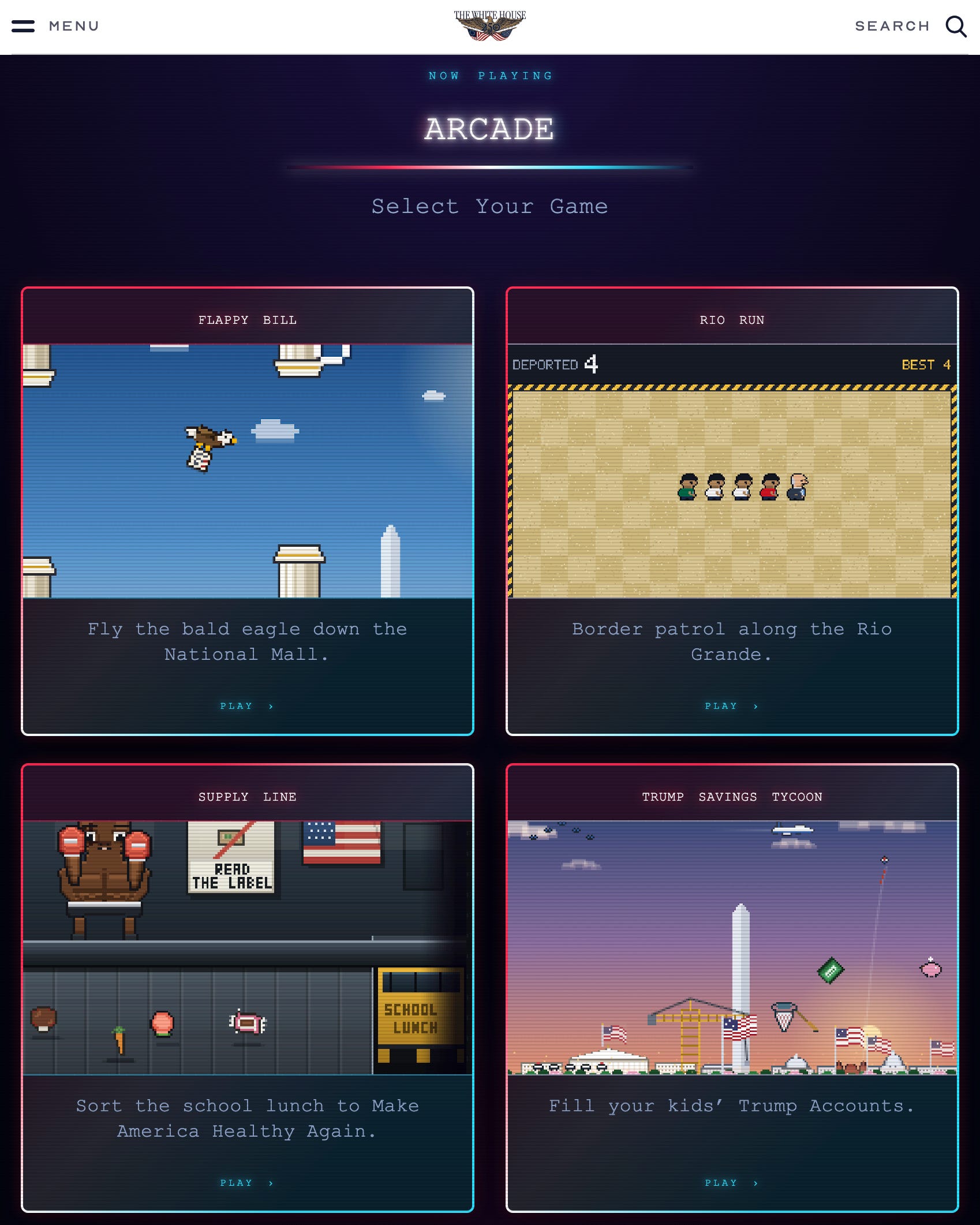
These efforts might seem unrelated, were it not for another development. In its social media announcement of the arcade, the White House used a MAGA logo modified from that of the Japanese game company Sega, set to music poached from another Sega product, Sonic the Hedgehog, and a series of boot screens modeled after those of the Microsoft Xbox, Nintendo Gamecube, and Sony PlayStation. And the game “Build the Wall” appeared to be a copy of Tetris, which was originally developed in a Soviet computer lab, and popularized on the Nintendo Game Boy. (This isn’t the first time it has crossed paths with the US government: Hillary Clinton was photographed playing Tetris on her Game Boy on Air Force One in 1993.)

If you’ve been reading this newsletter for any length of time, you’re undoubtedly aware that content is increasingly important to Japan. The government has made the support of production and export of intellectual property a top economic priority. More specifically, they’ve declared the content industry one of seventeen “strategic sectors,” making Japan the first country in history to frame cartoons as important to national survival as its defense industry. I exaggerate, but maybe only slightly: content really does seem to occupy a special place in the hearts and minds of leaders here, as METI’s interest in storytelling shows.
Japan grew rich in the 20th century by supplying the world with products essential and inessential. In the post-industrial 21st, with most of its manufacturing off-shored and its population shrinking, its leaders are attempting to ensure their nation’s future by building what I call a fantasy-industrial complex. This is, simply put, a system where government and private industry work together to make the production of content an engine for economic health and growth. However, there are many challenges to making this a reality. I have explored several of them at length in previous essays. The assimilation of Japanese content by AI companies is one. The appropriation of Japanese styles is another.
But perhaps the biggest concerns are closely entwined, and also neatly encapsulated by the White House’s arcade: politicization and theft. President Trump and his government agencies have been making prolific use of Japanese characters in social media posts, leading Japanese officials to issue a formal complaint. “Even public institutions must obtain permission from creators when using intellectual property,” they are reported to have communicated to the American embassy in June.
Japanese rights-holders lost the equivalent of $65 million to piracy last year alone. METI has had some success in petitioning foreign governments to take down pirate sites. But what do you do when the pirate IS a foreign government? It sounds like one of those crazy hypotheticals, but in appropriating logos, music, and even entire games, the Trump administration has officially taken it out of the realm of conjecture. Those diplomatic protests appear to be falling on deaf ears.
My first thought upon seeing the arcade was, man, these are some seriously old references. The Gamecube logo is from 2001. Sonic arrived in 1991, and Tetris dates back to the mid-Eighties. My second thought was how little things have changed over the last decade. As I wrote in the final chapter of the book that gives this newsletter its name, Japanese pop-cultural content like games and anime played an indirect but large part in galvanizing Trump supporters online in the lead-up to the 2016 elections. The White House Arcade is but the latest example of how those would “make America great again” still depend heavily on Japanese fantasies to appeal to their base.
The borrowing of imagery from Japanese entertainment for political purposes is nothing new. Japanese radicals were doing it in the Seventies. More recently, democracy activists in Nepal, Indonesia, Thailand, and Hong Kong used Japanese characters in their movements. Trump (or perhaps more specifically his media managers) have a history of posting Japanese imagery to appeal to his supporters, as do the agencies under his control. But these cases have been limited, until now, to social media posts. The efforts to promote the White House arcade may well mark the first time that a government has formally employed Japanese pop culture for the purposes of propaganda.
So what can Japan do? Not much. So far, Sega, Nintendo, and Sony have stayed quiet. (Perhaps Nintendo doesn’t want to stir the pot, as it is embroiled in a lawsuit to claw back tariffs from the US government.) The Tetris Company (who knew there was such a thing!) took to X to declare that it wasn’t involved in the making of the games, and that it “takes copyright infringement very seriously.” This seems to have worked, at least in the short term, as the White House took down “Build the Wall” this morning. But this is far from precedent. Legal claims rest on the assumption that the defendant doesn’t control the legal system in its entirety.
So the Japanese government is in a bind. It believes content is critically important to Japan’s future, but cannot admonish their most powerful ally, for the reason that its leader is too unpredictable (or, perhaps, all too predictable). Simple metrics may be another reason for the silence from Japan. The White House Arcade doesn’t seem to have stirred up much in the way of attention or outrage beyond the perpetually online; there’s only so far that knockoffs of forty-year-old games can take you, I guess.
For now, it is obvious that the Trump administration, rather than the original creators, are behind this wave of content being repurposed into propaganda. But that may not always be the case, and the time may come when the Japanese government feels the need to do more than “express concern” about their nation’s content being twisted for political ends. Should that happen during the current administration, it is all too easy to imagine things going very badly for everyone. Consider that America’s trade war with Canada can be traced back in part to a form of content: a Canadian political ad that enraged the President.
Content is usually categorized as a building block of soft power, but over two Trump administration, norms and rules of all sorts are being subverted. Soft power is no exception. Bizarre as it sounds, we are inching closer and closer to a moment when a video game or a cartoon or a comic book might trigger a diplomatic incident, or even a crisis. As the White House has demonstrated, this isn’t a hypothetical. It’s the world Japan is living in — in fact one it made, even if indirectly, as its intellectual properties transformed the lives of people around the globe. The real story here isn’t about the arcade. It’s that building a fantasy-industrial complex isn’t for the faint of heart.
Moments after I published this, Trump's social media team posted a meme incorporating "make America great again" into the Legend of Zelda logo. This arguably represents an escalation of their tactics, in that it seems to be timed to take specific advantage of the buzz surrounding Nintendo's latest Zelda release.
Good piece, Matt! Takaichi could learn some moves from Carney. . .