


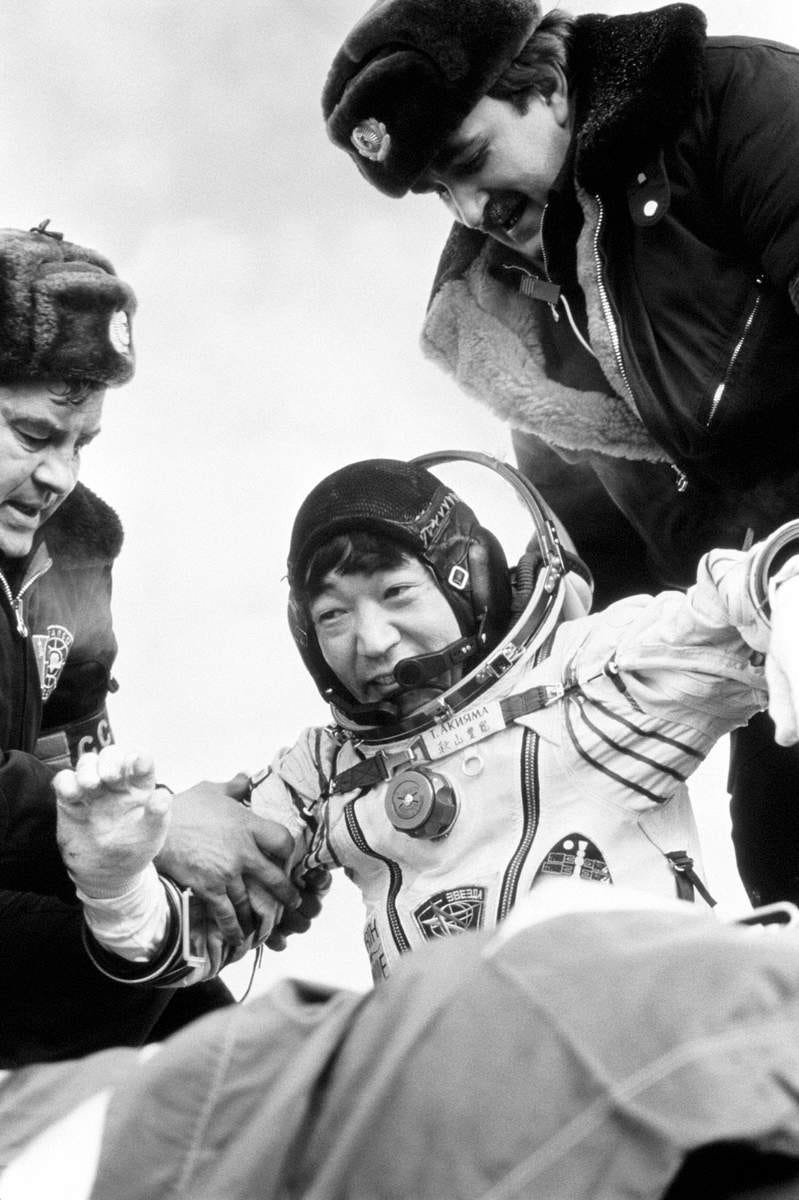
Toyohiro Akiyama has died at 84. You may remember his name from Pure Invention, for his story serves as a thematic pivot between Japan’s fall as an economic powerhouse and re-invention as a fantasy superpower. Truly, it is an evocative moment: in December of 1990, Akiyama rocketed into orbit inside a Soviet Soyuz capsule, docked with Mir, and became Japan’s first man in space. But he wasn’t a professional astronaut. He was a journalist sent up as part of a publicity campaign. His literal rise to and fall from the heavens symbolized the rise and collapse of Japan’s “Bubble economy.” It also presaged many things we now take for granted, such as civilian spaceflight, reality television, and livestreaming stunts.
Executives of the Japanese TV station TBS hatched the plan, ostensibly as a celebration of their company’s fortieth anniversary, agreeing to pay the Soviet Union the equivalent of $30 million USD to send a reporter up to Space Station Mir. The idea was to boost the underdog broadcaster’s image by beaming back a series of heavily promoted nightly week-long specials from orbit: Nihonjin Hatsu! Uchuu e (“The First Japanese in Space!”)
Think about this for a second, because it is difficult to fathom from our standpoint abreast three decades of economic stagnation. A Japanese TV station, not even the top station, had enough cash floating around to buy themselves into a Cold War superpower’s space program.
The scheme infuriated the Japanese government, as they were already cooperating with NASA to field an actual, trained astronaut by the name of Mamoru Mohri into space. It infuriated Soviet reporters, who were outraged their government would send a Japanese to the station instead of one of their own. Unruffled, Soviet apparatchiks, eager to turn the situation into a Cold War PR coup, bumped up the flight date to ensure that the first Japanese into space flew on their Soyuz rather than the American’s Shuttle.
TBS prepared a list of hundreds of applicants from among their employees. Soviet flight doctors winnowed this down to two final candidates. One was Ryoko Kikuchi, a 26 year-old camerawoman whose hobbies included mountain climbing, cycling, and skiing. The other was Akiyama, a 48 year-old journalist and four-pack-a-day smoker whose hobbies appeared limited to chronic overtime. Given the era, the final decision shouldn’t come as any surprise. Akiyama was an ideal every man in a society where middle-aged men essentially called all the shots. So it was that a chain-smoking, over-the-hill salaryman came to carry TBS’ multimillion dollar investment on his shoulders.
Despite it all, Akiyama had what it took to make it through cosmonaut training, a process on which the Soviets refused to compromise for safety reasons. On December 2, 1990, he soared into orbit aboard Soyuz TM-11. TBS naturally broadcast the entire thing, cutting between images of Akiyama’s nervous wife and a Marxist-chic control room filled with cartoonish, medal-adorned Soviet generals shaking hands. The Japanese government meanwhile maintained a stoic silence about the whole affair. What could they say? Their nation’s momentous first steps into space were being made on a Soviet rocket boldly festooned with the logos of an electronics maker, a pharmaceutical company, and a manufacturer of sanitary napkins.
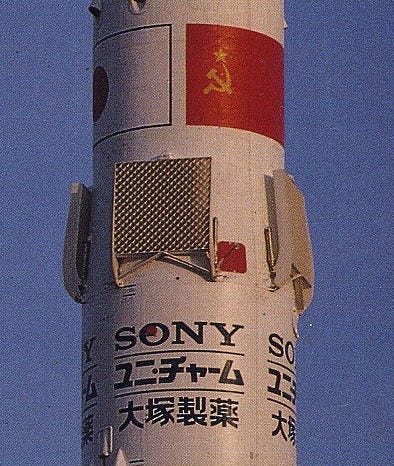
While Japanese business and the USSR forged a new partnership through this surreal moment of capitalist excess, Japan-bashing Western media gleefully portrayed Akiyama as a spaceborne stooge. They cast the hapless space tourist as a “whiskey-swilling idiot” and a “space antihero” while cherry-picking his most inane comments for translation, such as Hokkaido resembling “a yummy piece of kelp.”
It’s entirely possible that Akiyama had a more intellectual repartee planned, but he spent the vast majority of the flight plagued by space sickness so severe that one of his fellow cosmonauts remarked that he “had never seen a man vomit that much.” Akiyama gamely made his way through his daily scheduled broadcasts and conducted vague experiments with tree frogs in zero gravity (criminally overlooked by the Ig Nobel Committee), but today the consensus abroad seems to be that he “did not have a very productive flight.”
Then again, Akiyama’s sojourn was never about the Right Stuff. It was about the Right Ratings, a PR stunt of the sort that could only have originated in a smoky Bubble-era boardroom. But even from that standpoint, the flight seems to have been only a middling success, with viewership quickly dropping off after the initial excitement of the launch and docking at the station.
TBS undoubtedly envisioned Akiyama being feted with the local equivalent of a ticker-tape parade upon his return. But perhaps he was a little too everyman to become a hero. Akiyama’s first words in space were a less than charismatic “Are we really live?” and his final words after touchdown, a Homer Simpson-esque “I want a drink and a smoke.”
Memories of the flight evaporated from the public consciousness as quickly as wisps of liquid oxygen wafting from a rocket on its launchpad. No films, no manga or anime, nor even any books (save those written by the man himself) chronicle Akiyama’s ascent into the heavens. It’s hard to imagine any other nation’s first citizen in space being so thoroughly forgotten. Even Akiyama seemed to agree. “Even thirty years later,” he said in a 2018 interview, “I don’t feel like Japan’s first [in space]. It felt more like a business trip.”
Perhaps that’s because Akiyama’s reality TV exploits were soon replaced by the likes of pros like Mohri (who would have been Japan’s first astronaut, had the Challenger disaster not delayed his flight by five years) and other full-timers groomed by JAXA, Japan’s equivalent of NASA. Indeed, Japan now has a full cadre of professionally trained astronauts who have inspired society with their space experiences.
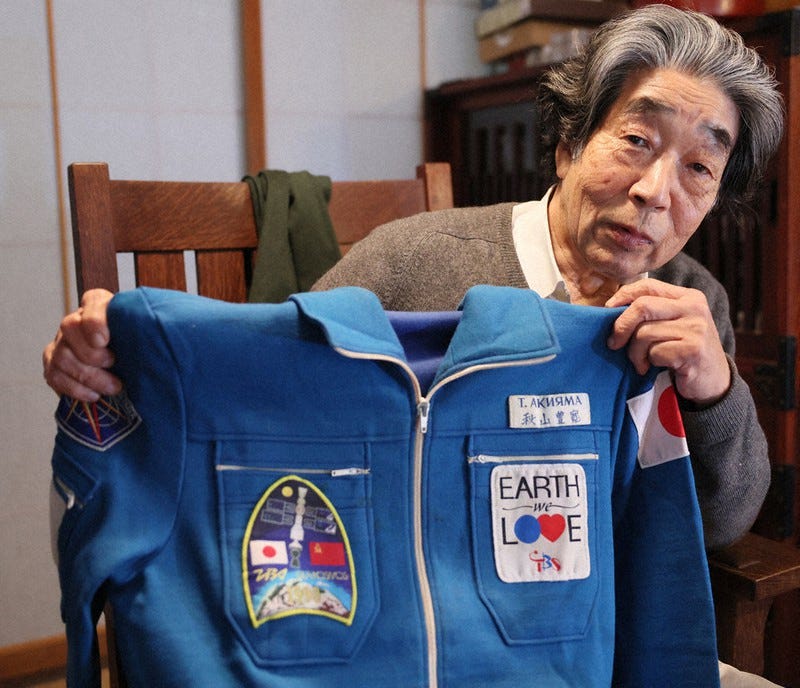
And what of Akiyama? Increasingly disillusioned with life at TBS, he quit shortly after his return from space, reinventing himself as an author and organic shiitake mushroom farmer in Fukushima. Forced to evacuate in the wake of the 2011 tsunami and nuclear disaster, Akiyama went on record speaking out against the government, Tepco, and the mass media. For a time he became a professor of agriculture at a university in Kyoto, then returned to farming again, in Mie prefecture.
Although Akiyama appeared from time to time as a TV commentator, for the most part he withdrew from public view after his heavily televised jaunt into the Final Frontier. But his exploits are a fitting symbol for his nation. Japan’s high-flying Bubble economy came down to Earth right around the same time Akiyama’s capsule did, and his quiet later years echo those of Japan’s quietly hyperageing society as a whole.
Great story, Matt. What strikes me is how perfectly Akiyama belongs to that particular moment in Japan: spectacularly over the top, slightly absurd, and somehow rather poignant in retrospect.
There’s also something wonderfully Japanese about spending $30 million to send a salaryman into space, only for him to come back and decide that growing shiitake mushrooms in Fukushima was a better use of his time.
I had never heard about this, but this is so cool. I love Japanese tv, bubble era boardroom hubris, and obscure Soviet history, so it’s a good mix of my interests.
Bringing it to modern Japan, I think if the right streetwear brand or surviving Shibuya indie fashion label gave it a look, that USSR flag with a Sony logo under it would go so hard on t shirts and sweaters.
Like how NASA stuff took off, I think Japanese corporate sponsored Soyuz stuff would be even cooler.
I would pay real money for it. That’s who I am, Matt.