


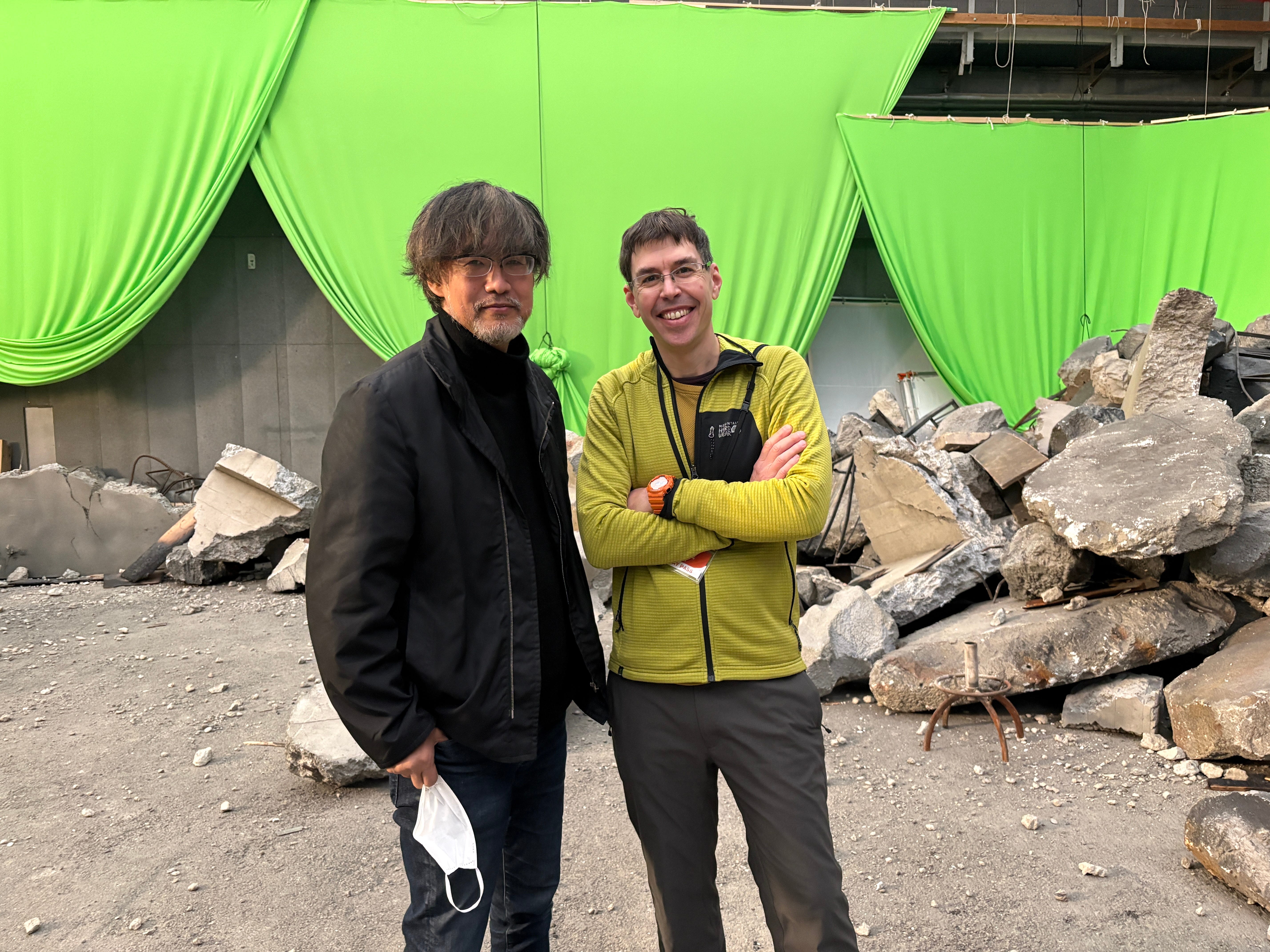
Over the course of three months starting in late 2025, I shadowed director Takashi Yamazaki while he worked on Godzilla Minus Zero, which just opened in American theaters. After a year of reporting, the profile is finally in The New Yorker. (There are no spoilers, I promise, so feel free to read even if you haven’t seen the film.) By all means check it out. Now, here on my newsletter, I wanted to share some thoughts that didn’t make it into the final cut due to various and sundry magazine things like column lengths and word counts and editorial notes about proper tone and voice and please stop mentioning Godzilla vs. Mechagodzilla (1974, of course, not 1993) every third paragraph.
I had a smile on my face the entire time I was reporting this. Every chance I had to go to the studio, I took. And every time I’d get on the train, I’d look around furtively at the other commuters, and think, none of them know there’s a Godzilla movie getting made right now. And getting to go felt like winning the lottery. Or, like, getting an invite to that discotheque in Godzilla vs. The Smog Monster. Or perhaps like being the kid in Godzilla vs Megalon, whose dad took him drag racing, and whose, uh, other dad built giant robots for him. Or maybe it felt like Nick Adams did the first time he saw Kumi Mizuno walk on set dressed in her form-fitting Xiliean wetsuit in Invasion of Astro-Monster. Or…
I’m sorry, was I raving? Can you blame me? Walking through the gates of Toho Studios, where so many of those kaiju movies I watched as a kid were made, never ceased to feel A Moment. I suppose this is where I should confess that this wasn’t actually precisely exactly my first time there. I snuck onto the lot back in 1994, when it was still largely unchanged from its Sixties heyday, still unpaved, the old pool where they filmed water scenes still standing, when you might catch a glimpse of a battered kaiju suit hanging in a storage shanty, or imagine a fading Hollywood star skulking off for another nip of saké in their trailer. Then I got escorted out at maser-point by security. But that’s a story for another time.
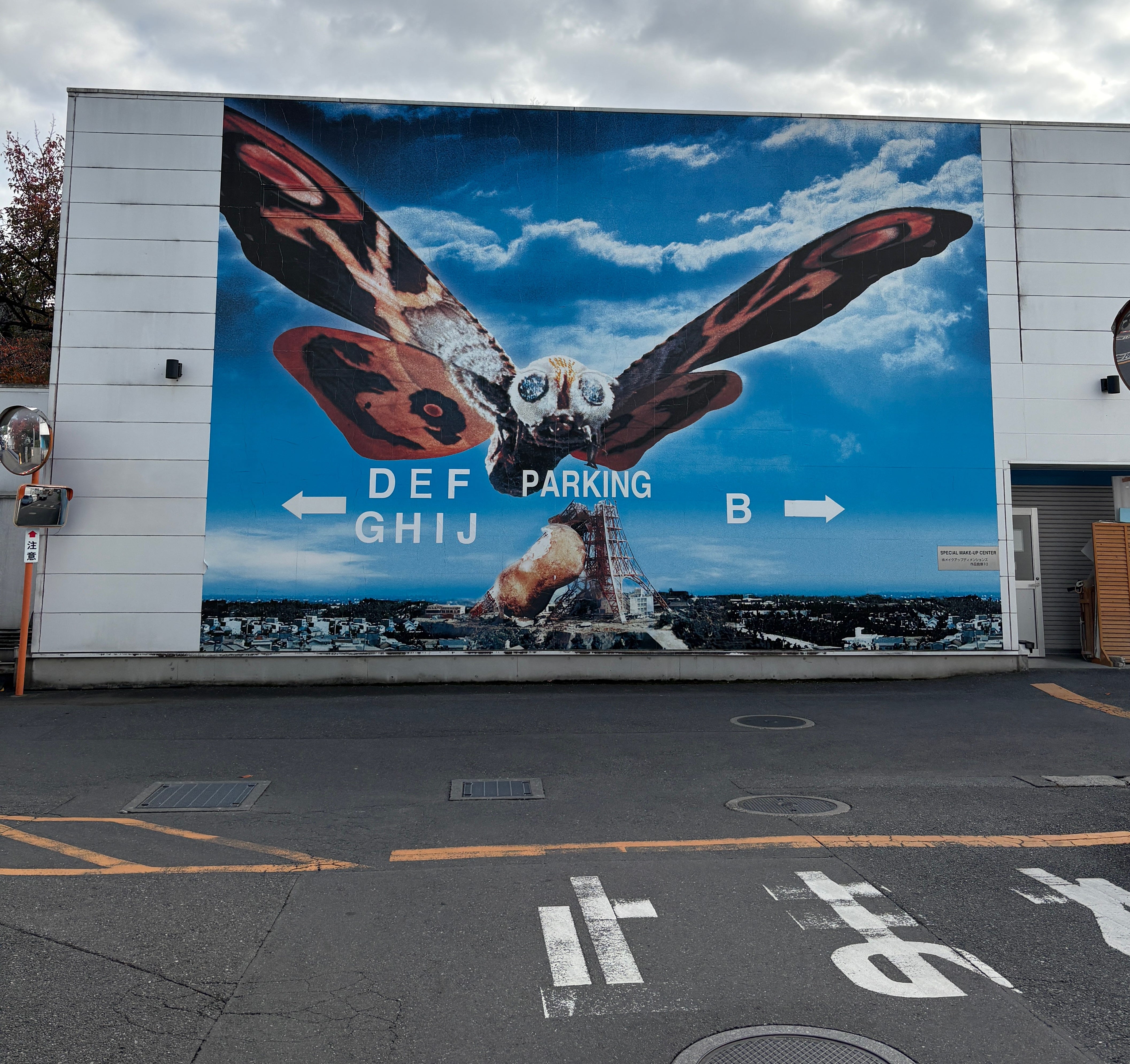
Toho Studios has changed a lot in the thirty years since. It was extensively renovated over the Aughts, from 2003 to 2010. Now it is modern, clean, arguably a little sterile. You won’t find any kaiju suits moldering in closets anymore. No more dirt roads. Beyond the gate now lies an office park with narrow paved streets. On that first visit, I seemed to be the only one walking them. The solitude reminded me of one of those old movies where the protagonist quips it’s quiet – too quiet, right before a giant insect swoops in to devour them. Or maybe I was just thinking this because I was walking beneath a enormous mural of Mothra. Now there was something you didn’t see growing up in the suburbs of Maryland.
Yamazaki’s a few years older than I am, but like him, I grew up on a similar whiplash mix of Eighties Hollywood and Seventies Toho flicks. There simply wasn’t anything quite like Godzilla on American screens, of the small or large variety. Star Wars, with its cutting-edge ultra-realistic effects, dominated the zeitgeist. But the Godzilla films occupied a homier niche in our fantasy lives, more often watched in living rooms than theaters, more often watched period, in those days before rentals or streaming. Sure, they were rougher around the edges, the English dubbing haphazard. (“Space titanium? You mean it’s from outer space?”) But they were also possessed of an exuberant playfulness, chock full of all the important stuff: kaiju and aliens and cyborgs and spaceships and insane architecture. Often all at once, such as Godzilla vs. Gigan, where cannibalistic alien cockroaches in possession of cyborg kaiju came up with the ingenious plan of disguising their secret base beneath a theme park shaped like Godzilla. Why this failed to beat The Godfather for Best Picture in 1972 is still an honest to god mystery to me.
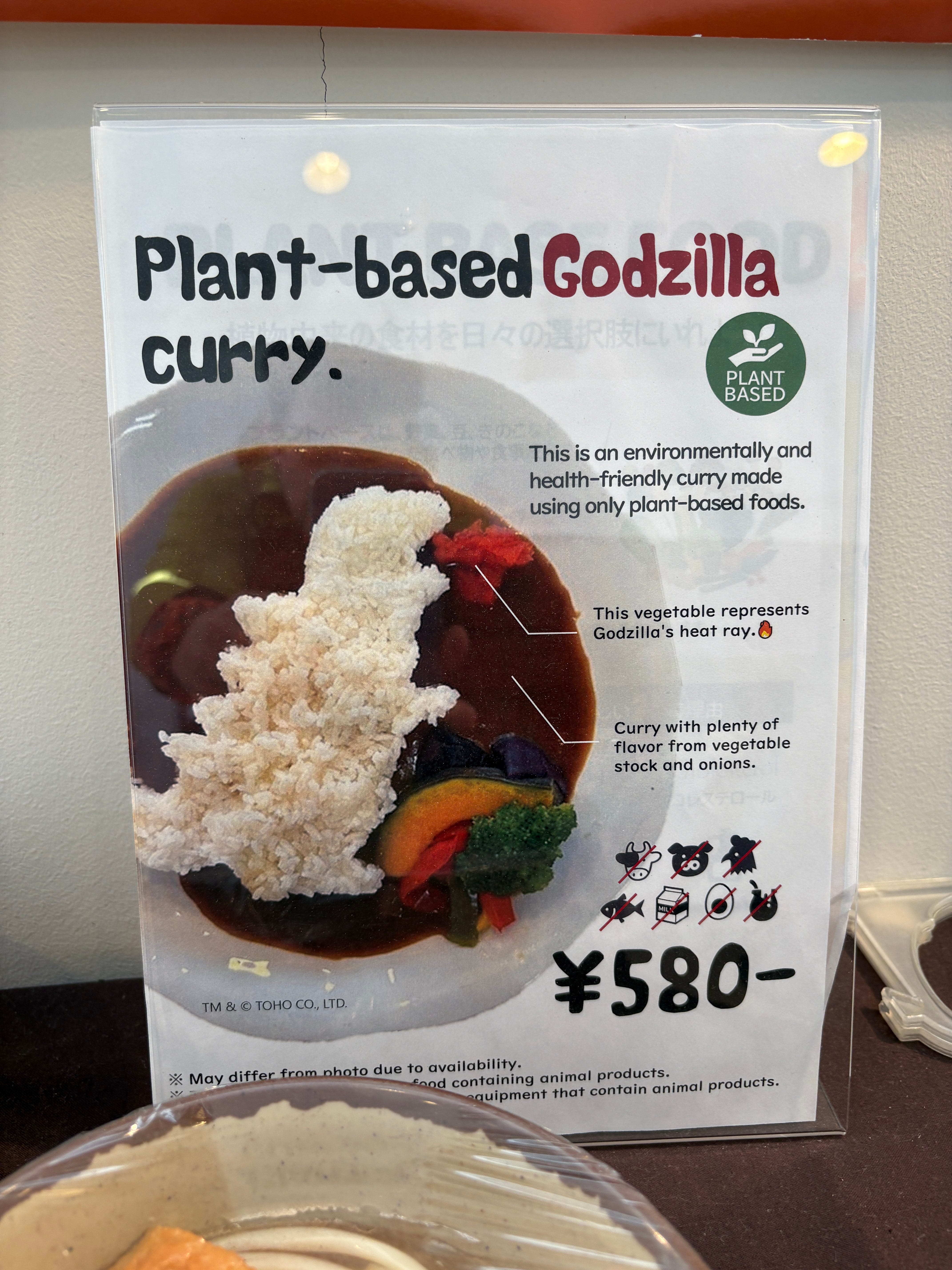
When I arrived at Studio 8, where Yamaguchi and his crew worked, I found a small army of delivery trucks, their hatch-back doors opened to reveal racks of supplies, surrounding the entrance. In a well-stocked snack area, someone had doodled Godzilla onto a box of instant soups. The love for the character was palpable on the set. Several of the producers were decked out in Godzilla garb, one of them literally head to toe: cap, satin jacket, socks, all with the King of the Monsters on them. Yes, I asked where he bought the jacket. This carried over into the lot itself. Most of the facility’s safety placards featured cute kaiju mascots, and the commissary (which isn’t open to the public, mind you) sold a “Godzilla Curry,” with the rice molded in the shape of the monster. No, I didn’t eat it. Not because I’m a big boy now, but because It was sold out every time I tried to order it. The cast and crew had gotten to it first.
I had pretty much free reign of the set on the days I was there. I made full use of it, going anywhere and everywhere I could. Every time Yamazaki would leave his directorial tent (erected to shade his monitors from the overhead lighting rigs), I’d scurry after like a cannibalistic alien cockroach clutching a reporter’s notebook in their mandibles, but truly, the notebook was just cover. I really just wanted to stand amidst the faux rubble and wreckage for a while and luxuriate in this newly discovered safe space of the kaiju movie set. Are you there, Godzilla? It’s me, Matt.
One thing I want to drive home is that Yamazaki is an honest to god nice guy. This sounds so trite as to be an abdication of journalistic-descriptive responsibility. Or a case of kaiju Stockholm Syndrome. (“Stockholm Syndrome? You mean it’s from Stockholm?”) But it’s true. He didn’t have assistants waiting on him hand and foot; in fact, he offered to do a coffee run at one point. Once, when I visited the set with Hiroko, he saw us standing and rushed up with folding chairs, which he insisted we use. To be a director means to impose your will on the world, or at least the part of the world in your immediate vicinity. I’ve been around directors who made a point of making sure everyone knew this, with all the performative wearing of sunglasses indoors, the performative tobacco and alcohol abuse, the performative fits of rage over minor setbacks.
There was none of this with Yamazaki. Zero. Minus Zero, even. I never once heard him raise his voice. I’m not sure I ever saw him frown, except in concentration. And there were many signs of real affection from his staff. Many of the stagehands had stylized stickers of his face on pieces of their gear. There was a lot of laughter on set. When the crew gathered for a commemorative photo, instead of “cheeeeeese,” they all shouted “Takashiiiii,” to his surprise and much general hilarity.
Japanese critics sometimes describe Yamazaki’s work as uettto (“wet”), slang for something overly sentimental and weepy. It’s true he’s a master of the tearjerker, a genre of which I am myself not a particular fan. But I believe Yamazaki comes by his sentimentality honestly. He is without exaggeration one of the most earnest people I know. I never heard him utter a cynical phrase. And I get the sense he really revels in manipulating audiences’ emotions.
At one point, the two of us watched a sequence I’d seen filmed on the soundstage, where Noda walked away from the clock tower, paused, and gave a little soliloquy. On set, it had been pretty straightforward. Now, with VFX in place, Noda’s last footstep placed him on the brink of a tall building. I felt my stomach clench at the potential fall. When I mentioned this to Yamazaki, he smiled and told me that triggering a physical response in viewers is an old filmmaker’s trick to reinforce an emotional moment.
I wanted to share another exchange that was a little too “in the weeds” for The New Yorker’s readership. It crosses over into Hiroko’s and my writing about folklore, and her recent book about Japanese spirituality. When I sat down to chat with Yamazaki at the Shirogumi offices, I asked about his inspirations for approaching Godzilla as a character, and he told me:
When I first saw [Hayao Miyazaki’s 1997 film] Princess Mononoke, I realized we have the concept of the tatartigami [curse-god] in Japan. The people getting cursed by it are beside the point. It just wants to convey that it’s angry. And I was like, ah, that’s it – Godzilla’s been a tatarigami from the start. This might be unique to Japan, but when there’s something incredibly angry it needs to be pacified in some way. And I think that’s where the very first Godzilla film comes from.
Godzilla is a metaphor. Not only for World War II, but for conflicts, for nuclear and hydrogen bomb testing, how the powers we unleashed ran out of control and transformed into a monster. I suspect Godzilla isn’t happy about being brought to life like this. It’s incredibly angry. It’s like a living thing turned kami, and is scattering its anger into the world.
Through a quirk of terrain, a river runs through Toho Studios, the Senkawa, and one must cross it to get to the soundstages. Rivers can be fraught places in Japanese spiritual lore, dividing lines between the here and the hereafter, and crossing the Senkawa always felt a little like that, even if the dividing line was just, like, between accounting and production. Even still, every time I walked across the bridge I had to refrain from shouting, like that guy in Son of Godzilla, “this is a real monster island!” I went there and back for you, and didn’t even get escorted out by security this time. Check it out at The New Yorker.