
Disorganized Religion
How Japanese spirituality sheds light on American faith
Recently, the writer Derek Thompson published a piece called “The Substack-ification of American Religion.” It takes the form of a dialogue with religious scholar Ryan Burge about a spiritual conundrum: even as Americans grow ever less religious, the nation seems to be experiencing a religious revival. Their theory: skepticism of authority figures and institutions is fueling both the flight away from organized religion and the rush towards what might be called disorganized religion: grassroots preachers who have more in common with YouTube influencers than they do traditional men and women of the cloth.
The pair reserve special scorn for what they call SBNRs – those who identify in surveys as “spiritual but not religious.” Thompson derides them as “Americans who have gone into religion as if it’s a foreign country, harvested certain souvenirs, and brought them back to the world of secularism. They practice yoga but have no interest in understanding its religious origins. They meditate but are not remotely interested in any Buddhist version of nirvana.” To which Burge agrees, “You can’t just pick and choose...A lot of people are doing that with religion right now. They’re walking down the buffet line, picking one piece, putting it on their plate, and calling it a spiritual life. That doesn’t endure.”
Doesn’t it? There’s a new book out that suggests a dramatic counterexample can be found in Japan. It’s called Eight Million Ways to Happiness, and was written by Hiroko Yoda, who is, as many of you know, my wife. It’s a memoir about re-engaging with Japan’s spiritual traditions after the loss of her mother. But Hiroko uses that framing to explore a spiritual conundrum of her own. How is it that surveys regularly rank Japan among the least religious countries in the world, when it has so many shrines and temples – more even than convenience stores?
Hiroko’s reporting leads her to the opposite conclusion of Thompson and Burge. Japanese spirituality endures precisely because locals pick and choose among numerous faith traditions, often without declaring particular allegiance to any, to suit the need or occasion or even simply mood, in a literal buffet of “spiritual pieces.” This “patchwork” spirituality has nourished many generations of Japanese, she argues, and underlies much of what outsiders love about Japanese culture. In fact it might be the defining feature of a nation where citizens only half-jokingly describe themselves as being “born Shinto, married Christian, and buried Buddhist.” And you might have noticed that Japan isn’t falling apart. In fact it seems to be doing a lot better than the US in many respects.
While the book centers on Japan, and more specifically its triad of major faiths of Shinto, Buddhism, and Shugendo, some of its most eye-opening moments happen when Hiroko is brought face to face with American religion. During the orientation for a high school study abroad program, she is urged to describe herself as Buddhist to Americans, despite the fact that neither she nor any of her classmates identify as such. Echoing Burge’s comment about America being “insanely religious,” the organizers tell the assembled that “America is a religious country. We need to give them some kind of a response.” (In a twist worthy of a David Sedaris essay, this episode ends with Hiroko in a Nativity scene in rural Indiana, cast inexplicably into playing the role of Jesus’ father, Joseph.)
How to explain how Japanese faiths co-exist with secular society to the point that Japanese don’t believe themselves religious? One answer lies in the definition, or rather translation, of “religion.” The word, Hiroko explains, is only of relatively recent import to Japan. Shukyo, as religion is known in Japanese, was only coined in the late 19th century, as a way to describe the organized, politicized religions of the West. Even though it is ostensibly neutral today, shukyo in fact retains subtle, almost subliminal, connotations of devout, evangelical Christian belief. So when you ask Japanese if they have it – as countless religious surveyors have – they inevitably answer in the negative.
Yet anyone who tallies these responses credulously is simply not doing their homework. Again, there are more religious sites in Japan than all the ubiquitous 7-11s and Lawsons’ and Family Marts put together.
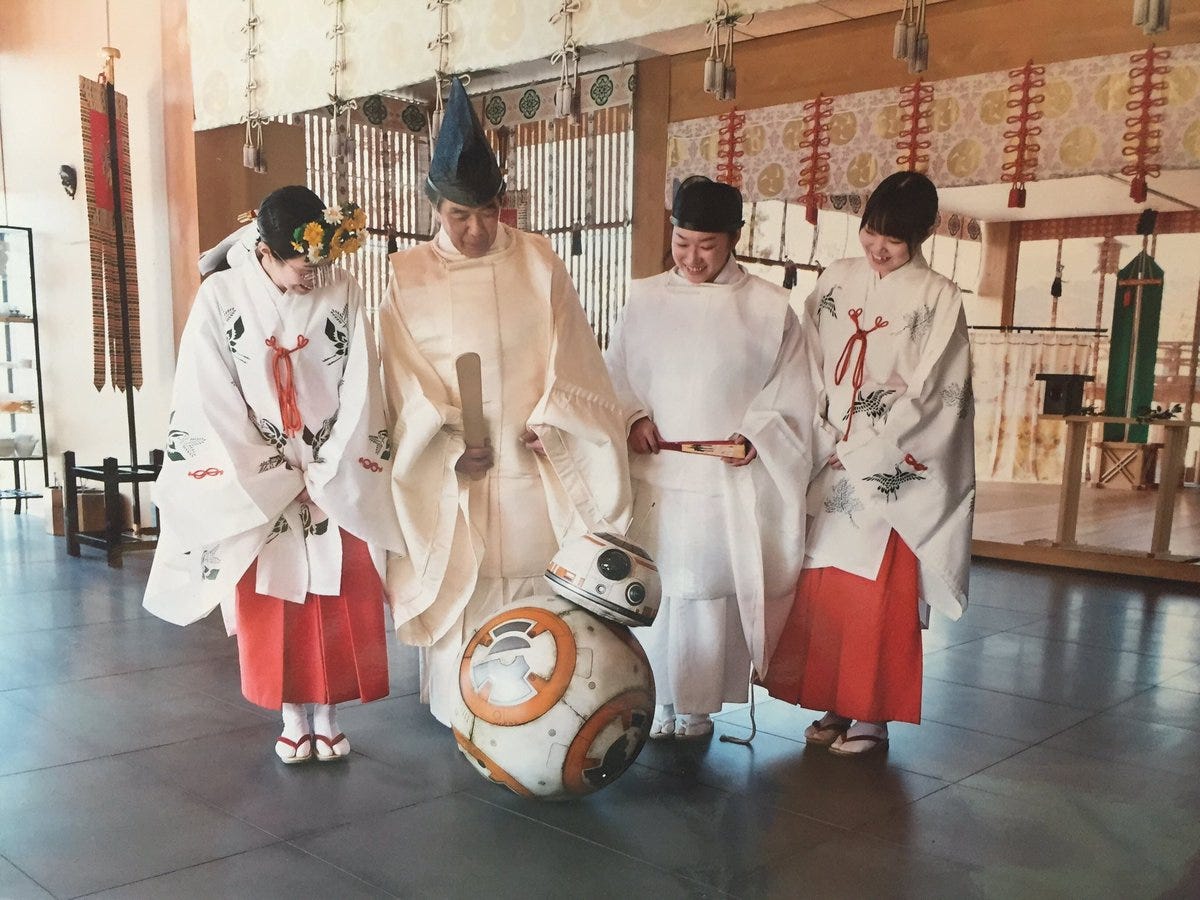
Tradition holds that the archipelago is home to what the Japanese call yaoyorozu-no-kami, the “eight million” deities, scare-quoted here because the idiom is evocatively poetic rather than mathematically specific. On my way home from an errand just now, I saw two earnest young Mormon missionaries (whom I like to imagine were both named Ernest) engaging an elderly Japanese in conversation. I always want to tell these guys, boy, do you have your work cut out for you. Not because Japanese won’t listen to you, but because your God has eight million rivals to contend with – evocatively-poetically speaking, of course. The traditional faiths of Japan aren’t evangelical, nor do their adherents seem to frame them as being in opposition to anything. As practiced by layfolk they’re more like lifestyles, often synonymous with Japanese culture itself. Which is another reason why so many people who, should they find themselves at a Shinto shrine, wouldn’t think twice of bowing, clapping, and praying might still declare themselves non-religious. And that Westerners who conflate spiritual nourishment with dogma might believe this.
One of the parts of Hiroko’s book I found most fascinating involved her linking of Japan’s modern tourist industry to the visiting of holy sites. Of course, holy sites are a pillar of the tourist trade today, as seen in the mobs of foreign visitors cramming in to Ryoan-ji’s Zen rock garden, Kiyomizu-dera’s verandas, or Meiji Jingu’s leafy pathways. But long ago, in the premodern era, the only way Japanese could get papers to travel outside of their town or city of residence was to declare themselves on a religious pilgrimage. As more and more citizens came to have wealth and leisure time, they took advantage of this loophole to see the world. In a kind of side-hustle, Shinto shrines and Buddhist temples began vending all sorts of things for visitors to remember their travels. You can see the modern incarnation of this in the bustling shopping arcades of Asakusa’s Senso-ji and many other temples and shrines. People often display the amulets or talismans they purchase there in their homes or places of business. What Thompson derides as harvesting spiritual souvenirs for the world of secularism, Hiroko frames in far more evocative terms: “prayer and play.”
So. On the one hand we have American pundits who believe picking and choosing among faiths is a symptom of a crumbling social compact. On the other, we have a hundred and twenty million Japanese who’ve been doing just that for as long as history has been recorded here. “My sense is that the West tends to be freer in terms of society and more rigid in terms of religion,” writes Hiroko. “Japan, I’ve come to realize, is the opposite: a nation with a rigid society but a surprising flexibility in regard to religion.” I’ve written a lot about how Americans (and Westerners) have come to resemble the Japanese. I wonder if Thompson and Burge are unwittingly revealing yet another.
It’s an interesting paradox, and if you’re interested in learning more, I highly recommend checking out Hiroko’s book (US edition here, UK edition here).


